Concept Studio
Demonstrations that show how an idea works: move it, run it, step through it.
Every demonstration here is free to try, with no account.
A demonstration happens on the screen, as a model. Practicals with real materials, each with a safety card, are in the Lab.
Demonstrations that match
Search and more filters
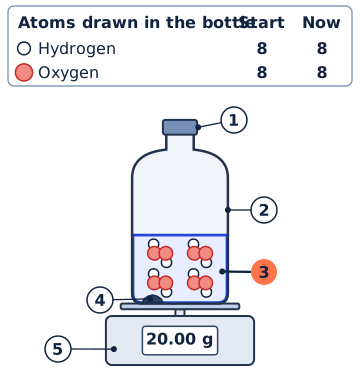
Atoms rearrange, and none are lost
Years 9–12Move it
Practise here, then learn it in full
Come back to any demonstration as often as you like. A learning subscription opens complete lessons on the platform, and a demonstration's page links its lesson where there is one.
No learning subscription can be bought yet.
Create a free accountFull list
Every idea in the Concept Studio's plan, by subject and school years. A title with a link is published and free to try; the others are not built yet.
Mathematics9 free to try
Kindergarten to Year 2
- Data displays: from objects to graphs, not built yetKindergarten to Year 4
- Mass and capacity: balances and jugs, not built yetKindergarten to Year 6
- Measuring length: same units, no gaps, not built yetKindergarten to Year 4
- Patterns: finding the unit of repeat, not built yetKindergarten to Year 2
- Sides and angles give a shape its namesKindergarten to Year 8
- Ten-frames: seeing numbers as parts of a whole, not built yetKindergarten to Year 2
- Angles as turns: right angles, protractors and degrees, not built yetYears 1–6
- Area: from covering squares to length times width, not built yetYears 1–6
- Arrays: multiplication as rows and columns, not built yetYears 1–6
- Money: making amounts and giving change, not built yetYears 1–4
- Odd and even: pairs with one left over, not built yetYears 1–4
- Ten ones make one tenYears 1–4
- The calendar: days, weeks, months and years, not built yetYears 1–2
- The two hands of a clock move togetherYears 1–4
Years 3 to 6
- A picture hides some faces, edges and verticesYears 3–8
- Decimals: zooming in on the number line, not built yetYears 3–6
- Elapsed time and 24-hour time on a timeline, not built yetYears 3–6
- Every fraction has a place on the number lineYears 3–6
- Reading scales: counting the gaps between marks, not built yetYears 3–6
- Solving equations: keep the balance level, not built yetYears 3–8
- Symmetry and transformations: slide, flip, turn, not built yetYears 3–6 and 9–10
- Angle sums: triangles and polygons, not built yetYears 5–10
- Cross-sections: slicing solids, not built yetYears 5–10
- Factors and primes: rectangles from counters, not built yetYears 5–8
- Integers: below zero on the number line, not built yetYears 5–8
- Linear relationships: from a growing pattern to y = mx + c, not built yetYears 5–10
- Misleading graphs: the truncated axis, not built yetYears 5–10
- Nets of a cube: which ones fold, not built yetYears 5–6
- Parallelograms and triangles: cut and rearrange, not built yetYears 5–8
- Percentages: parts of a hundred, not built yetYears 5–8
- The area model: from multiplying numbers to expanding brackets, not built yetYears 5–10
- The mean: a balance point and fair share, not built yetYears 5–8
- Two dice and the long runYears 5–10
- Views of solids: front, side, top and isometric, not built yetYears 5–8
- Volume of a prism, layer by layerYears 5–8
Years 7 to 10
- Circles: unrolling the circumference, rearranging the area, not built yetYears 7–8
- Distance-time graphs: the story of a walk, not built yetYears 7–10
- Parallel lines: corresponding, alternate and co-interior angles, not built yetYears 7–8
- Pythagoras' theorem: squares on the sides, not built yetYears 7–8
- Rates and ratio: scaling up a drip, not built yetYears 7–8
- Samples: how sample size changes the spread, not built yetYears 7–12
- Bearings: directions as angles from north, not built yetYears 9–12
- Box plots: five numbers that show a spread, not built yetYears 9–10
- Circle theorems: the angle in a semicircle, not built yetYears 9–10
- Congruence: which three facts fix a triangle, not built yetYears 9–10
- Growth: adding the same or multiplying by the same, not built yetYears 9–12
- Loans and annuities: balances over time, not built yetYears 9–12
- Logarithmic scales: each step is ten times, not built yetYears 9–12
- Measurement error: every reading has a range, not built yetYears 9–10
- Networks: vertices, edges and Euler trails, not built yetYears 9–12
- Non-right triangles: the sine and cosine rules, not built yetYears 9–12
- Parabolas: how a, h and k move the curve, not built yetYears 9–12
- Scatterplots: correlation and the line of best fit, not built yetYears 9–12
- Similar figures: lengths by k, areas by k squared, volumes by k cubed, not built yetYears 9–10
- Simultaneous equations: where two lines meet, not built yetYears 9–10
- Sphere volume: Archimedes' two thirds by slicing, not built yetYears 9–12
- Standard deviation: a typical distance from the mean, not built yetYears 9–12
- Surds: why A4 paper is 210 by 297, not built yetYears 9–12
- Surface area: unfolding a cylinder, not built yetYears 9–10
- Tree diagrams: with and without replacement, not built yetYears 9–12
- Trigonometric ratios: constant in similar triangles, read on the unit circle, not built yetYears 9–12
- Volume of pyramids and conesYears 9–10
Years 11 to 12
- A tangent's gradient is the limit of secant gradientsYears 11–12
- Complex numbers: multiplying is rotating and scaling, not built yetYears 11–12
- Continuous random variables: area is probability, not built yetYears 11–12
- Critical path: the longest chain decides the finish, not built yetYears 11–12
- Euler's number e: growing continuously, not built yetYears 11–12
- Filling vessels: height against time, not built yetYears 11–12
- Fractals: the longer your ruler, the shorter the coast, not built yetYears 11–12
- Optimisation: the biggest box from a sheet, not built yetYears 11–12
- Periodic models: tides and daylight as sine curves, not built yetYears 11–12
- Proof by induction: the Tower of Hanoi, not built yetYears 11–12
- Rotating a curve: volumes of solids, not built yetYears 11–12
- Slope fields: seeing a differential equation, not built yetYears 11–12
- The area under a curve: strips that close in, not built yetYears 11–12
- The Galton board: from coin flips to a bell curve, not built yetYears 11–12
Beyond school
- Fourier series: building any wave from sines, not built yetBeyond school
- Matrices: transforming the plane, not built yetBeyond school
- Taylor polynomials: curves that hug a function, not built yetBeyond school
Physics5 free to try
Kindergarten to Year 2
- Float or sink: it is not just how heavyKindergarten to Year 2 and Year 7–8
- Materials: the property decides the job, not built yetKindergarten to Year 6
- Pushes and pulls: a bigger push makes it go further, not built yetKindergarten to Year 2
- Shadows: light travels in straight lines, not built yetYears 1–6
- Sound: vibrations, pitch and loudness, not built yetYears 1–4 and 9–12
Years 3 to 6
- Heat transfer: conduction, convection and radiation, not built yetYears 3–8 and 11–12
- Levers: balancing a seesaw with the law of moments, not built yetYears 3–8 and 11–12
- Magnets: poles, forces at a distance and field lines, not built yetYears 3–8 and 11–12
- Charge flows only around a complete loopYears 5–6 and 9–10
- Falling: every mass speeds up alike under gravity, air pushes back, not built yetYears 5–10
- Heating: specific heat and latent heat, not built yetYears 5–6 and 11–12
- Light: reflection and refraction traced as rays, not built yetYears 5–12
- Solar panels and wind turbines: angle and the cube law, not built yetYears 5–12
Years 7 to 10
- Density: how much mass is packed in, not built yetYears 7–8 and 11–12
- Energy transfer: a pendulum and a marble on a ramp, not built yetYears 7–12
- Half-life: random decay, predictable halves, not built yetYears 7–12
- Only a net force changes motionYears 7–10
- Orbits: falling around a planet, not built yetYears 7–8 and 11–12
- Ramps: splitting weight into components, not built yetYears 7–8 and 11–12
- Springs: extension in proportion to load, not built yetYears 7–8 and 11–12
- Static electricity: moving electrons by rubbing, not built yetYears 7–8 and 11–12
- The pendulum: what sets the time of a swing, not built yetYears 7–8 and 11–12
- Acceleration is net force divided by massYears 9–12
- Colour: white light split and filtered, not built yetYears 9–10
- Electrical energy: power, time and the bill, not built yetYears 9–12
- Electromagnetic induction: moving a magnet makes a current, not built yetYears 9–12
- Energy efficiency: Sankey diagrams, not built yetYears 9–10
- Forces come in pairs, one on each objectYears 9–10
- Lenses: where the image forms, not built yetYears 9–12
- Line spectra: electrons jumping between levels, not built yetYears 9–12
- Ohm's law and I-V graphs, not built yetYears 9–12
- Rutherford scattering: finding a tiny nucleus, not built yetYears 9–12
- The Doppler effect: pitch of a moving source, not built yetYears 9–12
- The electromagnetic spectrum and glowing hot objects, not built yetYears 9–12
- The speed of sound: echoes and timing, not built yetYears 9–12
- Waves: energy moves on, the medium stays, not built yetYears 9–12
Years 11 to 12
- Alpha, beta and gamma: what stops each, not built yetYears 11–12
- Chain reactions: one split triggers more, not built yetYears 11–12
- Circular motion: the force points to the centre, not built yetYears 11–12
- Electric fields: field lines and equipotentials, not built yetYears 11–12
- Fluid flow: faster flow, lower pressure, not built yetYears 11–12
- Interference: light through two slits, not built yetYears 11–12
- Momentum in collisions: before equals after, not built yetYears 11–12
- Polarisation: light through two filters, not built yetYears 11–12
- Projectile motion: two independent motions, not built yetYears 11–12
- Superposition: standing waves and beats, not built yetYears 11–12
- The electron: cathode rays and quantised charge, not built yetYears 11–12
- The inverse square law: spreading over area, not built yetYears 11–12
- The motor effect: current in a magnetic field, not built yetYears 11–12
- The photoelectric effect: light arrives in packets, not built yetYears 11–12
- Time dilation: why cosmic muons reach the ground, not built yetYears 11–12
- Vectors: adding velocities and displacements, not built yetYears 11–12
Chemistry4 free to try
Kindergarten to Year 2
- Each separating method uses one propertyYears 1–8
- Physical or chemical change: is it a new substance, not built yetYears 1–8
Years 3 to 6
- Rusting: iron, water and oxygen together, not built yetYears 3–8
- Dissolving: solute, solvent and the solubility curve, not built yetYears 5–8
- Galvanic cells: electrons flow from the more reactive metal, not built yetYears 5–6 and 11–12
- Heating ice: where does the energy go?Years 5–8
Years 7 to 10
- Combustion: fuel, oxygen and heat, not built yetYears 7–10
- Distillation separates water from saltYears 7–8 and 11–12
- Elements, compounds and mixtures in particle diagrams, not built yetYears 7–8
- Energy changes in reactions: exothermic and endothermic, not built yetYears 7–12
- Acids, bases and the pH scale, not built yetYears 9–12
- Atoms rearrange, and none are lostYears 9–12
- Atoms shell by shell: the shape of the periodic table, not built yetYears 9–10
- Bonding: transferring and sharing electrons, not built yetYears 9–12
- Polymers: long chains from small units, not built yetYears 9–12
- Rates of reaction: collisions that count, not built yetYears 9–12
- Reactivity: a more reactive metal pushes out a less reactive one, not built yetYears 9–12
Years 11 to 12
- Buffers: resisting a change in pH, not built yetYears 11–12
- Colorimetry: concentration from colour, not built yetYears 11–12
- Dynamic equilibrium and Le Chatelier's principle, not built yetYears 11–12
- Gas laws: pressure, volume and temperature from particles, not built yetYears 11–12
- Homologous series: one more CH₂ each step, not built yetYears 11–12
- Isotopes and relative atomic mass, not built yetYears 11–12
- Molecular shapes: electron pairs push apart, not built yetYears 11–12
- Organic reaction pathways: a map of functional groups, not built yetYears 11–12
- Precipitation: ions that will not stay dissolved, not built yetYears 11–12
- Reading spectra: infrared, mass and NMR, not built yetYears 11–12
- Spontaneity: enthalpy, entropy and temperature, not built yetYears 11–12
- The mole: counting particles by weighing, not built yetYears 11–12
Biology1 free to try
Kindergarten to Year 2
- Classification: building a dichotomous key, not built yetKindergarten, Year 3–4 and Year 7–8
- Life cycles: seed to plant, egg to beetle, not built yetKindergarten to Year 4
- Plants: water up the xylem, out through the stomata, not built yetKindergarten to Year 2, Year 7–8 and Year 11–12
- What plants need: light and water, not built yetYears 1–6
Years 3 to 6
- Adaptations: features that help survival, not built yetYears 3–6
- Food webs and the energy pyramid, not built yetYears 3–8
- Flowers: parts, pollination and fertilisation, not built yetYears 5–6 and 9–12
Years 7 to 10
- Diffusion and osmosis across a membrane, not built yetYears 7–8 and 11–12
- Lungs: gas exchange across thin walls, not built yetYears 7–8 and 11–12
- Photosynthesis and respiration: a gas balance in light and dark, not built yetYears 7–8 and 11–12
- Plant cells have parts that animal cells lackYears 7–8 and 11–12
- Population growth: exponential start, limited finish, not built yetYears 7–8 and 11–12
- Predator and prey: linked cycles, not built yetYears 7–8 and 11–12
- Sampling populations: quadrats and mark-recapture, not built yetYears 7–8 and 11–12
- The heart and double circulation, not built yetYears 7–12
- Cell division: mitosis and meiosis side by side, not built yetYears 9–12
- Disease spread: the SIR model and herd immunity, not built yetYears 9–12
- DNA: the double helix and how it copies, not built yetYears 9–12
- Enzymes: shape, substrate and temperature, not built yetYears 9–12
- Evidence for evolution: the same bones, different jobs, not built yetYears 9–12
- Inheritance: Punnett squares and chance, not built yetYears 9–12
- Microbes: invisible, everywhere, and reduced by washing, not built yetYears 9–12
- Natural selection: who survives to breed, not built yetYears 9–12
- Surface area to volume: why cells are small, not built yetYears 9–12
- The eye: focusing and glasses, not built yetYears 9–12
- The reflex arc: fast and automatic, not built yetYears 9–12
Years 11 to 12
- Cooling by sweating and its limit, not built yetYears 11–12
- From gene to protein, and what a mutation changes, not built yetYears 11–12
- Gel electrophoresis: sorting DNA by size, not built yetYears 11–12
- Haemoglobin: loading oxygen in the lungs, unloading in muscles, not built yetYears 11–12
- Kidneys and dialysis: filtering the blood, not built yetYears 11–12
Earth and space2 free to try
Kindergarten to Year 2
- The Moon is always half litYears 1–8
- The night sky: stars wheel around the south celestial pole, not built yetYears 1–4 and 7–8
- The solar system to scale: sizes and distances, not built yetYears 1–10
- The Sun's path and shadows through a day, not built yetYears 1–8
Years 3 to 6
- Seasons come from Earth's tiltYears 3–8
- Weathering, erosion and deposition, not built yetYears 3–8
- Measuring the Earth with two shadows, not built yetYears 5–8 and 11–12
Years 7 to 10
- Deep time: 4600 million years on one line, not built yetYears 7–8 and 11–12
- Earthquakes: P and S waves and finding the epicentre, not built yetYears 7–8 and 11–12
- Eclipses: shadows in a line, not built yetYears 7–8
- Inside the Earth: layers sorted by density, not built yetYears 7–8 and 11–12
- Minerals: hardness, streak and lustre, not built yetYears 7–8 and 11–12
- Plate boundaries: what happens where plates meet, not built yetYears 7–12
- Rock layers and fossils: reading the order of events, not built yetYears 7–8 and 11–12
- Slopes and shaking: angle of repose and liquefaction, not built yetYears 7–8 and 11–12
- The rock cycle: one rock becomes another, not built yetYears 7–8
- Tides: the Moon's pull on the oceans, not built yetYears 7–8 and 11–12
- Volcanoes: runny or sticky magma, not built yetYears 7–8 and 11–12
- What moves the plates: slab pull and mantle flow, not built yetYears 7–8 and 11–12
- The expanding universe: every galaxy moving apart, not built yetYears 9–12
Years 11 to 12
- Stars: colour, brightness and the HR diagram, not built yetYears 11–12
- Tsunamis: fast in deep water, tall near shore, not built yetYears 11–12
Environment and sustainability3 free to try
Kindergarten to Year 2
- Weather: rain, wind and temperature measured, not built yetKindergarten to Year 6
Years 3 to 6
- Soil layers and ground coverYears 3–8
- Soil: sand, silt and clay, not built yetYears 3–4 and 7–12
- The Sun lifts water, and cooling brings it backYears 3–8
- Fire in Australian landscapes, not built yetYears 5–8
- Humidity and dew point, not built yetYears 5–8
- Salinity: salt water and plant growth, not built yetYears 5–6 and 9–12
Years 7 to 10
- Groundwater fills the spaces in the rockYears 7–8 and 11–12
- Water treatment: from muddy to drinkable, not built yetYears 7–8 and 11–12
- Ocean acidification: carbon dioxide into seawater, not built yetYears 9–12
- Ocean currents: cold, salty water sinks, not built yetYears 9–12
- Sea level: land ice and sea ice, not built yetYears 9–12
- The carbon cycle: stores and flows, not built yetYears 9–12
- The greenhouse effect: energy in, energy out, not built yetYears 9–12
Years 11 to 12
- Milankovitch cycles: Earth's orbit and ice ages, not built yetYears 11–12
Geography
Kindergarten to Year 2
- From a model to a map: the bird's-eye view, not built yetKindergarten to Year 4
- Seasons as Country knows them: an Aboriginal seasonal calendar, not built yetYears 1–4
Years 3 to 6
- Map scale and grid references, not built yetYears 3–8
- Catchments: where the rain goes, and the flood peak, not built yetYears 5–8 and 11–12
- Climate graphs: rainfall bars and temperature lines, not built yetYears 5–8
- Contour lines: from a hill to a map, not built yetYears 5–8
- Latitude, longitude and why flat maps stretch, not built yetYears 5–8
- Urban heat: surfaces that store the Sun's energy, not built yetYears 5–8
Years 7 to 10
- Coasts: longshore drift and groynes, not built yetYears 7–10
- Dunes: wind, sand and plants, not built yetYears 7–8
- Rivers: meanders, cut banks and deltas, not built yetYears 7–8
- Thematic maps: choropleths, flows and buffers, not built yetYears 7–10
- Population pyramids: a country's age structure, not built yetYears 9–10
Technologies1 free to try
Kindergarten to Year 2
- Systems: input, process, output, not built yetKindergarten to Year 4
- Loops and branches: tracing a program, not built yetYears 1–4 and 7–8
- Pixels: images as numbers, not built yetYears 1–4 and 7–8
Years 3 to 6
- Algorithms: searching and sorting, counted step by step, not built yetYears 3–6 and 9–10
- Passwords and ciphers: counting the guesses, not built yetYears 3–10
- Structures: why triangles and deep beams, not built yetYears 3–6 and 9–10
- Counting in binary: each place is worth doubleYears 5–8
- Gears: trading speed for turning force, not built yetYears 5–8
- Networks: messages in packets, not built yetYears 5–8
Years 7 to 10
- Hydraulics: pressure passed through a liquid, not built yetYears 7–8
- Compression: shorter codes for common patterns, not built yetYears 9–10
- Databases: tables and queries, not built yetYears 9–10
- Feedback control: a thermostat, not built yetYears 9–10
- Logic gates: AND, OR and NOT from switches, not built yetYears 9–10
English
Kindergarten to Year 2
- Letter formation: where to start and which way to go, not built yetKindergarten to Year 4
- Sound boxes: hearing and blending the sounds in a word, not built yetKindergarten to Year 2
- Cohesion: the ties that hold a text together, not built yetYears 1–6
- Sentence builder: main clauses and dependent clauses, not built yetYears 1–8
- Word building: prefixes, bases and suffixes, not built yetYears 1–6
Years 3 to 6
- Narrative structure: orientation, complication, resolution, not built yetYears 3–10
- Modality: from might to must, not built yetYears 5–8
Years 7 to 10
- Essay structure: an argument map, not built yetYears 7–12
- Film language: shot size and camera angle, not built yetYears 7–12
Agriculture and food
Kindergarten to Year 2
- Germination: water, warmth and air, not built yetYears 1–2 and 7–10
Years 3 to 6
- Yeast: living cells that make bread rise, not built yetYears 3–8 and 11–12
Years 7 to 10
- Food safety: the temperature danger zone, not built yetYears 7–10
- Emulsions: keeping oil and water mixed, not built yetYears 9–10
- Fair trials: replication, randomisation and blinding, not built yetYears 9–12
- Food energy: kilojoules on the label, not built yetYears 9–10
Years 11 to 12
- Legumes: bacteria that fix nitrogen, not built yetYears 11–12
History
Kindergarten to Year 2
- Timelines to scale: years, centuries and millennia, not built yetYears 1–8
Years 3 to 6
- Maps that change over time, not built yetYears 5–8
Music
Years 3 to 6
- Note values: how long each note lasts, and how notes fill a bar, not built yetYears 3–8
Languages
Years 7 to 10
- Italian nouns: gender, number and the words that agree, not built yetYears 7–10
Demonstrations with simplified models, to explore an idea. They are not reviewed experiments or lessons. Each page gives its review line and its sources.