Big ideas, one small skill at a time.

Learning is a tree of small, connected skills. See what each skill builds on, learn it step by step, and know what comes next.

  1. See what each skill builds on.

    Year 5 Mathematics, from the learning platform’s own sequence. Open a skill to see what it needs.

    Next up

    • Measurement and space
    • Number and algebra
    • Statistics and probability
    • Needs both

    The suggested order is a guide, not a lock, and skills from an earlier year are optional revision.

  2. Each lesson teaches one skill.

    Each lesson recalls what the skill builds on, teaches it step by step, then gives practice with three hints per question.
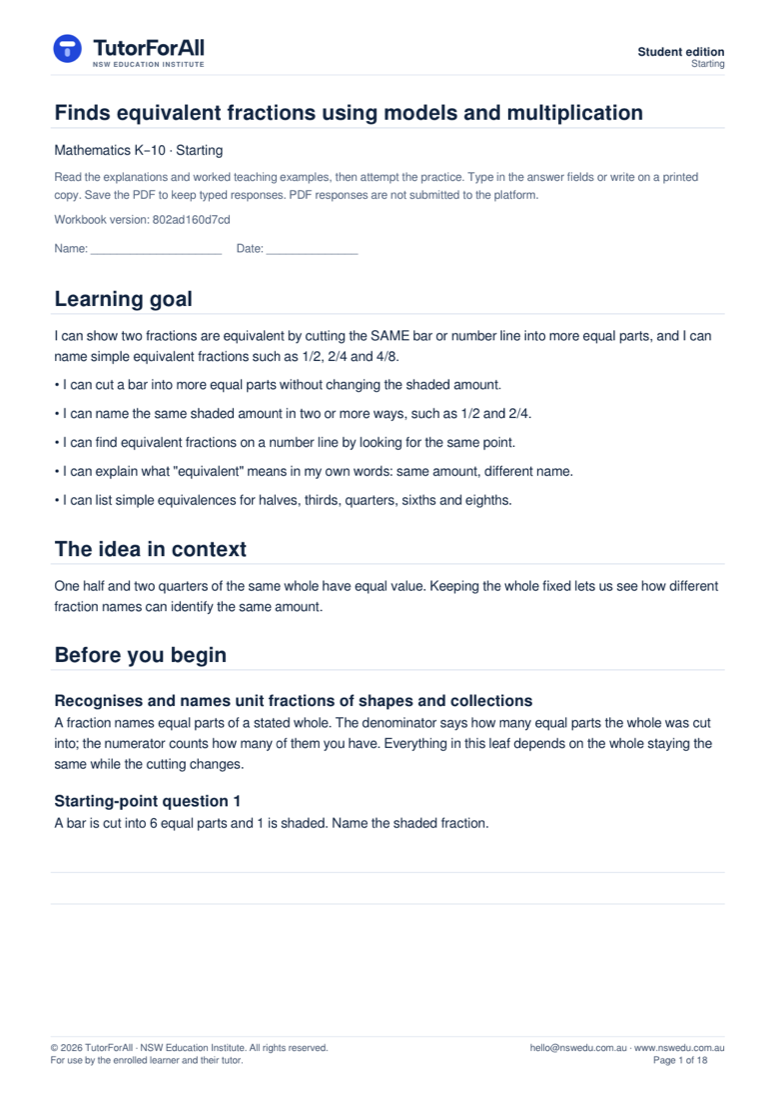
    Inside one lesson: Finds equivalent fractions using models and multiplicationThe lesson is written at four levels: Starting, Developing, Strong, Exceeding; this is the Starting level. Its parts, in order: 1 Introduction, 2 Prerequisite review, 3 The idea, 4 Worked examples, 5 Practice set, 6 Common errors, 7 Extension. In the practice set, each question has three hints that open one at a time: What is this asking?, then First step, then All but the last. The same lesson prints as a 18-page workbook.Finds equivalent fractions usingmodels and multiplicationStartingDevelopingStrongExceeding1Introduction2Prerequisite review3The idea4Worked examples5Practice set6Common errors7ExtensionHints, one at a time1What is this asking?2First step3All but the lastPrintable workbook18 pagesPage 1 of the printable workbook for Finds equivalent fractions using models and multiplication
    Inside one lesson: Finds equivalent fractions using models and multiplicationThe lesson is written at four levels: Starting, Developing, Strong, Exceeding; this is the Starting level. Its parts, in order: 1 Introduction, 2 Prerequisite review, 3 The idea, 4 Worked examples, 5 Practice set, 6 Common errors, 7 Extension. In the practice set, each question has three hints that open one at a time: What is this asking?, then First step, then All but the last. The same lesson prints as a 18-page workbook.Finds equivalent fractions using models and multiplicationStartingDevelopingStrongExceeding1Introduction2Prerequisite review3The idea4Worked examples5Practice set6Common errors7ExtensionHints, one at a time1What is this asking?2First step3All but the lastPrintable workbook18 pagesPage 1 of the printable workbook for Finds equivalent fractions using models and multiplication
    See question 1 and its hints

    A bar is cut in half and one half is shaded. Each half is then cut in half again. Parts now: ___ Shaded parts: ___ Equivalence: 1/2 = ___

    1. What is this asking?You are renaming the same shaded amount after extra cuts; this rests on naming a unit fraction of a shape.
    2. First stepCut each half of the bar down the middle, keeping exactly the same region shaded.
    3. All but the lastCount every equal piece in the whole bar, then count only the shaded pieces, and write the shaded count over the total count.
    Lessons teach with worked examples and diagrams.
  3. Loading the next steps