Science 7–10 · Year 10
Newton's second law: accelerating a trolley with hanging masses
Physical sciences — Waves and motion: motion and Newton's laws (NSW Stage 5 focus area)
This Lab page has no on-screen model. Where a step or a material names a model, simulation or tool, it was planned when the practical was written and is not on this site; an external simulation a step names (for example PhET) is not part of this site.
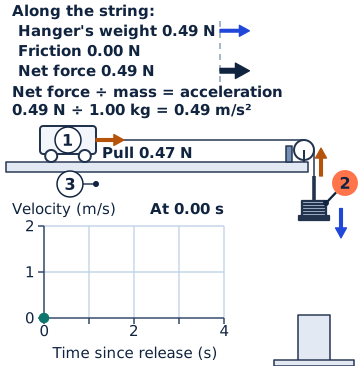
The idea is shown as a demonstration in the Concept Studio: Acceleration is net force divided by mass.
The idea
The acceleration of an object is proportional to the net force on it and inversely proportional to its mass, so F = m a can be tested by changing one and measuring the other.
See it in the Concept Studio
What you need
- dynamics trolley 1.0 kg with low-friction wheels, 1
- 1.5 m runway or bench with a pulley clamped at the end, 1
- string 1.5 m, 1
- slotted masses 10 g x 10 with hanger, and 500 g bars x 2 to load the trolley
- two light gates with timer, or a motion sensor, or a ticker timer, 1 set
- interrupt card 10.0 cm for the light gates, 1
- metre rule and wooden wedge to tilt the runway, 1 each
How to do it
- Friction compensation: tilt the runway with the wedge until the trolley, once nudged, rolls at constant speed (equal light-gate times or evenly spaced ticker dots).
- Tie the string to the trolley, pass it over the pulley and hang the 100 g hanger. Place the light gates 0.50 m apart, and set the release point so the hanger is still clear of the floor when the trolley passes the second gate.
- Release the trolley from rest before the first gate; record the speed at each gate and the time between them; acceleration = (v2 - v1) / t. Three runs, average.
- Force series: move mass from the trolley to the hanger in 10 g steps so the total accelerating mass stays 1.10 kg, giving hanging forces of 0.098 N up to 0.98 N. Record the acceleration for each.
- Mass series: keep 100 g hanging and add 500 g and then 1000 g to the trolley. Record the acceleration for each total mass.
- Plot acceleration against force (straight line through the origin) and acceleration against 1 / total mass (straight line through the origin); find the gradients.
What you should see
With 100 g hanging (force 0.98 N) and a total moving mass of 1.10 kg the acceleration is 0.89 m/s^2 and from rest the trolley covers 0.50 m in 1.06 s; measured values are lower where friction compensation is imperfect. Doubling the hanging force doubles the acceleration. In the mass series the acceleration falls to 0.61 m/s^2 for 1.60 kg and 0.47 m/s^2 for 2.10 kg, so acceleration x total mass stays 0.98 N. The acceleration against force graph has gradient 1 / (1.10 kg) = 0.91 per kg. The learner knows it worked when both graphs are straight through the origin.
What changes
- What you change
- hanging force (N) with total mass fixed, then total mass (kg) with force fixed
- What you measure
- acceleration (m/s^2)
- What you keep the same
- friction-compensated runway
- same string and pulley
- release from rest at the same point
- total moving mass constant in the force series
Common misconceptions
Each of these ideas is wrong, and the practical is a chance to test it.
- A constant force produces a constant speed.
- The hanging mass's weight is the only mass being accelerated.
- A stationary trolley with a small hanging mass has a net force on it.
Safety card
Hazards
- hanging masses falling on feet
- trolley running off the runway end
Controls
- sand tray or padding under the pulley
- buffer at the runway end
- feet clear of the drop zone
Note
No hazardous chemicals or naked flames are used. Complete the school's risk assessment for the activity before the lesson; the NSW Department of Education Science safety and compliance page points to CSIS 1.7 (Risk assessment – a pre-requisite for risk control) for how to carry it out.
Curriculum references
The NSW syllabus outcomes and Australian Curriculum v9 codes this practical supports. They are references, not a verified or complete curriculum alignment.
- Science 7–10 Syllabus (2023)SC5-WAM-02SC5-WS-04SC5-WS-05SC5-WS-06
- Australian Curriculum v9AC9S10U05AC9S10I02AC9S10I03AC9S10I04AC9S10I05
Sources
The pages the author read to write this practical.
- curriculum.nsw.edu.au/learning-areas/science/science-7-10-2023/outcomes
- curriculum.nsw.edu.au/learning-areas/science/science-7-10-2023/content/stage-5/faafd3c3df
- spark.iop.org/investigating-newtons-second-law-motion
- spark.iop.org/relationships-between-acceleration-force-and-mass
- spark.iop.org/trolley-and-falling-mass
- spark.iop.org/compensating-friction