Mathematics 11–12 · Year 12
Volume of a rotated solid checked with water: a cone and a curved glass
Further applications of calculus: Areas between curves and volumes of solids of revolution (Mathematics Extension 1, Year 12); Integral calculus: The definite integral (Mathematics Advanced, Year 12)
This Lab page has no on-screen model. Where a step or a material names a model, simulation or tool, it was planned when the practical was written and is not on this site; an external simulation a step names (for example PhET) is not part of this site.
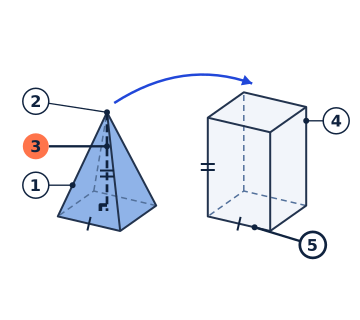
The idea is shown as a demonstration in the Concept Studio: Volume of pyramids and cones.
The idea
Rotating a line or curve about an axis sweeps out a solid whose volume is the integral of pi y^2, and pouring water into the real object measures the same number.
See it in the Concept Studio
- Volume of pyramids and conesStep through it
What you need
- A conical paper cup or a filter funnel with its outlet sealed (measure its rim radius and depth)
- A stemmed glass with a curved bowl
- Vernier callipers or a ruler, a 250 mL measuring cylinder, water
How to do it
- Measure the cone's rim radius r and depth H and write the line y = (r/H) x for 0 <= x <= H.
- Compute V = pi times the integral of y^2 dx from 0 to H and compare with pi r^2 H / 3.
- Fill the cone to the rim from the measuring cylinder and record the volume poured.
- For the glass, measure the bowl's radius at depths 0, 1, 2, ... cm from the bottom of the bowl and fit y = k sqrt(x) to the profile.
- Integrate pi y^2 over the measured depth, fill the glass to that depth and compare.
What you should see
A cone of rim radius 4.0 cm and depth 10.0 cm gives V = pi times the integral of (0.4x)^2 dx from 0 to 10 = 167.6 cm^3 = 167.6 mL. A bowl that fits y = k sqrt(x) is a paraboloid with V = pi r^2 h / 2, so the same rim radius and depth give 251.3 mL, one and a half times the cone. Filling the cone to half its depth holds one eighth of the full volume, 20.9 mL. The learner knows it worked when the poured volume matches the integral within the reading error of the cylinder (half its smallest graduation) plus the rim uncertainty.
What changes
- What you change
- depth filled
- What you measure
- volume of water
- What you keep the same
- same vessel
- cylinder read at eye level
- profile measured at fixed depth steps
Common misconceptions
Each of these ideas is wrong, and the practical is a chance to test it.
- The volume is pi times the area under the curve; it is the integral of pi y^2, so each radius is squared.
- Half the depth holds half the water; in the cone half the depth holds one eighth.
Safety card
Hazards
- glass breakage
- water spills
Controls
- work over a tray
- wipe spills at once
Note
No chemicals and no heat are used, so the NSW Department of Education Chemical Safety in Schools package does not apply; ordinary classroom supervision.
Curriculum references
The NSW syllabus outcomes and Australian Curriculum v9 codes this practical supports. They are references, not a verified or complete curriculum alignment.
- Mathematics Extension 1 11–12 Syllabus (2024), Year 12 focus area Further applications of calculus; Year 11 taught from Term 1 2026, Year 12 from Term 4 2026, first HSC examination 2027 (the 2017 syllabus is still taught to Year 12 until then); page read 2026-09-22ME1-12-05
- Mathematics Advanced 11–12 Syllabus (2024), Year 12 focus area Integral calculus; Year 11 taught from Term 1 2026, Year 12 from Term 4 2026, first HSC examination 2027 (the 2017 syllabus is still taught to Year 12 until then); page read 2026-09-22MAV-12-05
- Australian Curriculum v9No Australian Curriculum v9 code is listed.
Sources
The pages the author read to write this practical.